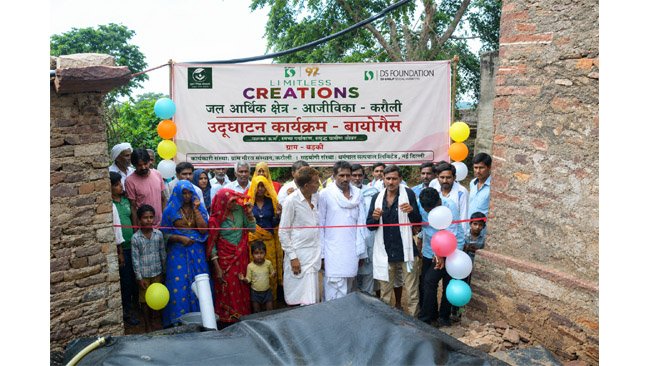
Karauli, August, 2026.
Dharampal Satyapal Group (DS
Group), a leading FMCG conglomerate and
multi-business corporation, has announced the “Biogas
Village” initiative in Karauli, Rajasthan, to promote clean cooking
energy, sustainable agriculture and climate-resilient rural livelihoods.
In first phase, the initiative will support the
installation of 300 household biogas units, converting locally available cattle
dung into renewable cooking fuel.
The initiative builds on DS
Group’s ongoing Water Economic Zone (WEZ) project, implemented in
partnership with Gram Gaurav Sansthan, across vulnerable communities in
Karauli. The region faces recurring droughts, erratic rainfall, groundwater
depletion and limited livelihood opportunities, with agriculture and livestock
remaining central to rural incomes.
Over the years, the WEZ
project has brought together interventions spanning water conservation, climate-resilient
agriculture and dairy development. These include water-harvesting structures
such as Pokhar, Pagara, Taal and Anicut; WADI models for fruit and vegetable
cultivation; improved practices for paddy, pearl millet and pigeon pea;
Bio-Resource Centres and Custom Hiring Centres; as well as model cattle sheds,
green fodder development, veterinary services and community-based dairy
support.
The Biogas Village
initiative emerged from two household biogas units installed as
demonstration models under the dairy interventions. The experience provided
valuable insights into the feasibility of converting cattle dung into a
reliable source of clean household energy.
Speaking on the occasion, Mr Prabhakant Jain,
General Manager, Sustainability and CSR, DS Group, said, said, “For us, sustainability is
about creating solutions that deliver value across generations. The Biogas
Village initiative by DS Group brings energy, agriculture, livelihoods and
environmental stewardship into one integrated model. Through the initiative, DS
Group and Gram Gaurav Sansthan demonstrate how locally anchored solutions can
help build climate-resilient communities at scale.”
The biogas units will help
participating households reduce dependence on firewood, crop residues and dung
cakes, while improving air quality and reducing the time and effort associated
with traditional cooking fuels. The process will also produce bio-slurry, a
nutrient-rich organic input that can be used in agriculture to improve soil
health and reduce dependence on chemical fertilisers.
By linking livestock, clean
energy and agriculture, the initiative seeks to create a circular rural model
in which locally available resources generate multiple benefits—for households,
farms and the environment. It also strengthens the larger objective of the WEZ
project to build resilient communities through integrated interventions rather
than isolated solutions.
The 300 units will serve as
the foundation for developing Biogas Villages across the region. Learnings from
implementation will help assess adoption, demonstrate the potential for
community-level scale-up and encourage wider uptake of decentralised
clean-energy solutions.
© 2019 All Rights Reserved | democraticjagat2019 | Developed By DIIT IT SERVICES & SOLUTIONS