New Delhi,
June, 2023.
National Skill
Development Corporation (NSDC) and National Council for Vocational Education
and Training (NCVET), under the aegis of Ministry of Skill Development and
Entrepreneurship (MSDE) through Sector Skill Councils (SCCs) demonstrated its
unwavering commitment to make vocational education and skill training
aspirational for Indian youth through strengthening the public-private
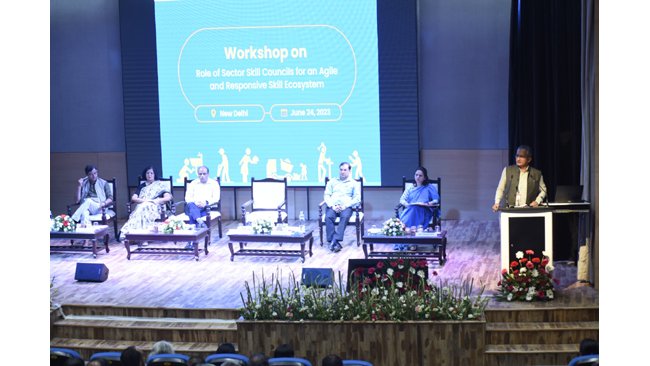
partnership. MSDE conducted a workshop to discuss the critical role of SSCs in
making the skill ecosystem more agile and response to industry needs by
reimagining and redesigning their roles making them more effective and
impactful. The workshop saw discussions on the need for industry driven skill
training programs for various job roles in different sectors to cater to the
industry needs.
The workshop
was held in thepresence of Shri Atul Kumar Tiwari, Secretary, MSDE,Dr. N S
Kalsi, Chairman, NCVET; Dr. K K Dwivedi, Additional Secretary, MSDE; Ms.
Trishaljit Sethi, DG, DGT; Ms. Sonal Mishra, Joint Secretary, MSDE; Dr. Neena
Pahuja, Executive Member, NCVET; Shri Nilambuj Sharan, Sr. Economic Advisor,
MSDE; and Shri Ved Mani Tiwari, officiating CEO, NSDC and MD, NSDC
International.
The event
brought together all 36 SSCs along with their CEOs/representatives along with
the Chairpersons of some of the SSCs. It focuses on mapping skills and
qualifications aligning with international standards to equip youth with a
competitive edge and agility for international markets. It also envisions to
prioritize awareness and counselling sessions on designing long-term training
programs to meet the demand of high-skilled personnel in overseas markets.
The
establishment of industry partnered state-of-the-art infrastructure in new-age
courses and skilling programs in various fields ranging from AI, machine
learning, blockchain and others, will facilitate on-the-job training,
integrating real-world work scenarios and guidance from industry expert that
aid in boosting overseas mobility and improved placements.
Speaking at the event, Shri Atul Kumar Tiwari, Secretary of the
Ministry of Skill Development and Entrepreneurship (MSDE), emphasized the
importance of public-private sector collaboration in realizing Prime Minister
Narendra Modi's vision of making India a technological powerhouse. He highlighted
the need for a centralized and outcome-oriented approach that integrates
curriculum development and experiential learning courses, with Sector Skill
Councils (SSCs) playing a pivotal role.
Shri Atul Tiwari emphasized the significance of the Recruit, Train, and
Deploy (RTD) model, which offers emerging talent opportunities to upgrade their
skill sets, gain accredited training, and enhance their employability. He also
highlighted the demand for trainers and assessors in the capital goods and iron
and steel industry, presenting a lucrative opportunity to develop customized
training programs that align with industry needs and enhance the job readiness
of the youth. He expressed his belief that such collaborations would establish
credible pathways, enabling skilling programs to receive the recognition they
deserve for hands-on learning and for improving the employability of the
nation's youth.
Furthermore,
the Ministry and SSCs discussed the skill gap study to devise appropriate
skilling interventions to bridge the gap. The study has been performed across
trainers and assessors, job roles, centre of excellence and fee-based
curriculum to comprehend the magnitude and nature of the skill gap. The study
reveals that the top five trainers and assessors in terms of PMKVY job roles
are Iron and steel, capital goods, apparel, power and IT/ITes. On the other
hand, the most in demand job roles for PMKVY are textile, electronics and
rubber chemical and petrochemical, which presents a promising opportunity to
upskill the youth in relevant sectors and boost employability.
The meeting saw
concrete discussions around the idea of creating skill gap studies at the
state/regional/cluster level to address migration and other externalities. This
could be a game-changer in understanding workforce dynamics and bridging gaps
focusing on localized solutions for a stronger and more sustainable economy.
SSCs also discussed embracing micro-credentialing of job roles to boost
employability in various sectors. By recognizing skills, individuals can stay
relevant in today's fast-paced job market.
The meeting
also emphasized on the need of promoting the benefits of apprenticeship for
vocational education and training qualifications to cater to the needs of
higher education and school students. These courses will be designed on
industry validated occupational standards and current market requirements to
run at ITI, polytechnics, and other technical institutions.
Reaffirming its
commitment to build a scalable, transparent and sustainable mechanism for skill
development efforts, the SSCs focuses on strengthening the industry connect to
comprehend the evolving skill requirements, emerging trends and job roles in
line with equipping the youth with new age skills. It develops content and curriculum
for various Qualification packs (QPs) in regional languages to address language
barriers and improve the learning outcomes. Localization of training delivery,
continuous feedback and assessments are some other measures that shall be
incorporated to
amplify the impact of skill development initiatives.
© 2019 All Rights Reserved | democraticjagat2019 | Developed By DIIT IT SERVICES & SOLUTIONS