Mumbai, December, 2021.
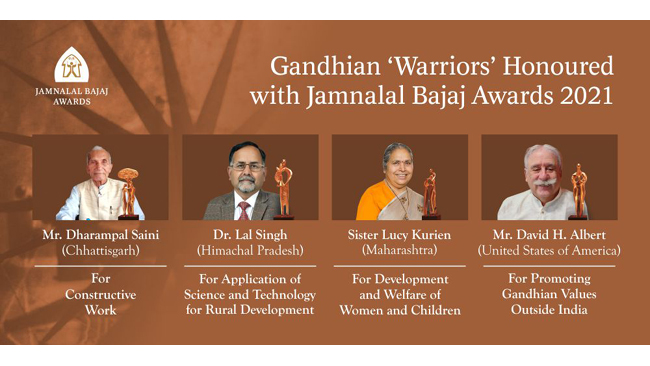
The 43rdannual Jamnalal Bajaj Awards 2021, organized by the Jamnalal Bajaj Foundation, was held today, where four individuals were felicitated and honoured for their humanitarian work. Theseawards presented on or around the birth anniversary of Shri Jamnalal Bajaj recognises the exemplary efforts of people in the field of humanitarian and social work following Gandhian ideologies. The four awardees were felicitated in the presence of the ChiefGuest Nobel Peace Laureate Shri Kailash Satyarthi, Founder of Kailash Satyarthi Children’s Foundation, Shri Rahul Bajaj, Chairman and Board of Trustees of Jamnalal Bajaj Foundation, Dr. R. A. Mashelkar, Chairman, Council of Advisors of the Foundation, Chairpersons of the Selection Committees, Members of the Council of Advisor of the Foundation, and the august gathering.
Since the institution of these awards, the Foundation
commemorates the birth anniversary of Shri Jamnalal Bajaj every year. As a
tribute to the great man on this special occasion, the Foundation felicitated
achievers in the field of developmental activities and Gandhian constructive
programmes by presenting them with a citation, a trophyand a prize amount of
INR 10,00,000/- in each category. The Foundation continues to serve the ideals
to which Shri Jamnalalji was dedicatedly been involved during his lifetime.
The details of the awards for this year (2021) are:
|
Award Category |
Awardee Name and Title |
State / Country |
|
Award for outstanding
contribution in the field of Constructive Work |
Shri Dharampal Saini |
Chhattisgarh |
|
Award for Application of
Science & Technology for Rural Development |
Dr. Lal Singh |
Himachal Pradesh |
|
Award for
Development and Welfare of Women and Children (Instituted in memory of
Smt. Jankidevi Bajaj) |
Sister Lucy Kurien |
Maharashtra |
|
International
Award for Promoting Gandhian Values Outside India |
Mr. David H Albert |
United
States of America |
Shri Rahul Bajaj, Chairman, Board of
Trustees, Jamnalal Bajaj Foundation addressing at the occasion said, “We
congratulate all the winners as they have contributed to the society with their
exemplary work.It is very important to recognize these individuals and
honour their efforts, so that more people get inspired by their unflinching
selflessness. The winners have each contributed a lot in their own way to the
propagation of the Gandhian principles and it is exactly this that Shri
Jamnalalji desired. The Foundation is proud and privileged to recognize such
people who have touchedso many lives and transformed them emotionally,
economically and socially.”
About the 2021
Winners
Shri Dharampal Saini
Recipient of the Award for Outstanding
Contribution in the field of Constructive Work - 2021
A courageous
and humble worker, Dharampal Saini was immersed into the ideas and philosophy
of Mahatma Gandhi, Vinoba Bhave and Swami Vivekananda from an early age. He has
been an activist for education, development and against untouchability. A great
believer in Gandhian principles, he has supported the holistic development of
the youth, fair price in markets and forest produce.
Following is a brief description of activities
undertaken by him:
·
Sainiji
developed Rupa Kheda village without any government assistance. He started
education among women through the discussion of development, shramdan.
·
From Rupa Kheda
to Machla and from there Harijan Sevak Sangh in Indore became the area of life
and work of Sainiji. As an activist for the prevention of untouchability and
organizer of the state's Drug Ban Committee, he was involved in the
rallies/padyatra, camps, conferences as well as in writing and organizing them independently.
·
During the
period from 1962 to 1970 Saini was engaged in constructive work. Then, Sainiji
got an opportunity to work as the principal of Panchayati Raj Training School.
He also got opportunity to get trained as a Shanti Sena volunteer (peacekeeping
force) under the guidance of Narayanbhai Desai at Jayprakash Narayan’s village
Sokhdevara Ashram.
·
From 1970 to
1974, as the official convenor of Bhil Sevak Sangh in the tribal districts of
Madhya Pradesh, Sainiji developed the new generation with new ideas and
original values by the light of education from Ashram schools.
·
In 1976, he
established Mata Rukhmani Sewa Sansthan with Bastar district as its centre.
Today 2500 boys and girls living in about 600 villages study in 37 ashrams
whose thoughts, conduct, ability, quality and employment provide an economic
and social development.
·
In the Haat
Bazaar of Bastar, Saini has also made significant and successful efforts to
reduce malpractice and to support fair price of forest produce. He supported
the Tamarind Movement of Bastar and contributed to its economic development.
·
The Sansthan
also actively participated in the 'Indravati Bacho' movement and contributed in
effective ways for organizing it with the support of 65 local communities.
· With regards to the Maoist issues prevailing in the region, Dharampal Saini strongly believes that it can be resolved by educational development in Bastar, public infrastructure development, healthcare, agriculture and forest produce businesses thus leading to propagation of peace and brotherhood following Gandhian ideologies..
Dr. Lal Singh
Recipient of the Award for Application of Science and Technology for Rural
Development – 2021
A Botanist by education Dr. Lal Singh took a tough decision to work in the voluntary sector to make meaningful use of his scientific knowledge and training so as to help in improving the socio-economic conditions of people living in the remote mountainous areas of Himachal Pradesh through Himalayan Research Group. He is of a firm belief that capacity building of local communities, especially of the women folk in mountains for energy, health, food and nutrition and livelihood through modern science and technology is the only way to achieve self-reliance and see the rural areas developing as was the dream of the Father of the Nation.
Following is a brief description of activities
undertaken by him:
·
He established
the Himalayan Research Group (HRG) the 1997, one of the core groups of the Department
of Science &Technology, (Government of India) since 2005 and supported by
other national and international agencies.
·
He helped
conserve the Himalayan tree Taxus wallichiana (Commonly known as Yew) due to
large-scale harvesting of leaves for a chemotherapy drug. He developed a simple
and cost effective “rooting of cutting technique” for mass propagation of the
tree.
·
In order to
strengthen the livelihoods, biodiversity conservation, climate change
resilience and overall development of communities in rural difficult areas of
mountain topography, he helped develop a basket of technology models for the
community. Dr. Lal Singh made simple, cost effective and easy to follow
techniques for adoption.
·
His
community-oriented, environment-friendly technology model of clean solar
energy, vermicomposting, high value medicinal plants cultivation of two species
Swertia cordata (Chirayita) and Picrorhizakurrooa (Kutki), button mushroom
cultivation and revival of native crops earned high returns to the community
which sustained these activities for the last two decades.
·
Dr. Singh
refined and upscaled the facilities for developing community seed bank to
conserve native crops and develop community farm products premium line along
with Ayush Pharmacy for furnished high value primary healthcare products.
·
His HRG
technology-based initiatives directly involves men and women groups organized
in 750-900 households, annually with average direct benefits of about Rs. 40-45
lakh/annum through described science & technology activities.
·
HRG is able to
reach to more than 18000 households across states of Himachal Pradesh (HP),
Uttarakhand, Ladakh and Arunachal Pradesh for demonstration of different need
based technology models. Activities in Himachal are in 309 villages of 6
districts, 12 villages in Kargil district of Ladakh, 2 villages of Dehradun in
Uttarakhand, and 2 villages in Bomdila districts in Arunachal Pradesh.
·
His efforts were
recognized by the state of HP for developing the Mountain Solar Water Heating
System (Solar Hamam) in 2018. The system was validated by National Solar Energy
Institute (NISE) for efficiency in 2020. Till now more than 1200 mountain solar
water heating systems stand installed in HP, Ladakh and Uttarakhand.
·
Dr. Lal Singh
also worked in hardcore research work related to diseases of forests, climate
change mitigation, fungal biotechnology, bio-prospecting over these years in
collaboration with national and international institutes and individuals.
Sister Lucy
Kurien
Recipient of the Award for Development and Welfare
of Women and Children – 2021
Sister Lucy Kurien is committed to co-creating a
better India by establishing Maher homes for women and outreach programs in
every Indian state and to collaborating with leaders who feel called to create
spaces “where society’s vulnerable can rise to new life.” Being a true Gandhian
follower Sr. Lucy believes “Be the change you want see in the world.
Following is a brief description of activities
undertaken by her:
·
In 1997, Sister
Kurien founded Maher, which means “Mother’s Home”, to provide a safe haven for
battered and destitute women in one small home near the village VadhuBudruk
near Bhima Koregaon on Ahmednagar highway.
·
Her tireless
efforts and the work of the dedicated staff led to the expansion of Maher
activities to nearby areas. These include the villages in Shirur, Haveli and
Khed talukas as also the city of Ratnagiri, Miraj & Satara in Maharashtra.
·
Beyond
Maharashtra, Maher has established homes in Kerala, Jharkhand, Kolkata,
Karnataka and Andhra Pradesh. In 2011, unable to ignore the plight of abandoned
men on the streets, Maher opened its first home for destitute, aged and
mentally challenged men.
·
Today Maher
reaches the life of the poorest of the poor through as many as 24 different
outreach projects including 624 village self-help groups and 58 interfaith,
caste-free homes that currently shelter 984 children and 142 men and over 572
destitute women in the Indian states of Maharashtra, Kerala, Kolkata, Andhra
Pradesh, Karnataka and Jharkhand.
·
Since its
founding, Maher has provided care and shelter to more than 5000 children and
5900 women. It started the Swavlamban project – Self Help Groups (SHGs) in the
villages. The project consists of generating and sustaining SHGs in the village
of Maharashtra and Jharkhand. At present
Maher is having 652 SHGs and are reaching out to 10,608 beneficiaries.
·
Sister Kurien
established Maher as an interfaith organization which seeks the help and
blessing of all religions and faiths in its work for the weak and poor
around. In 2017, she founded the
Interfaith Association for Service to Humanity and Nature (IASHN).
·
Her love for
the environment prompted her to start awareness drives on tree planting.
Mr. David H. Albert
Recipient of the International Award for Promoting
Gandhian Values Outside India - 2021
Born in New York city, Mr. David H. Albert gave up a
promising academic career to become a student of Gandhi. And was mentored by
the Gandhian and Quaker activist George Willoughby. He has worked on land
reform efforts and the upliftment of Dalit families in India. He funded a
publishing house in USA to propagate Gandhian ideals globally and has since
worked towards education and public health.
Following is a brief description of activities
undertaken by him:
·
He worked for
40 years on land reform efforts in Tamil Nadu, providing land for more than
15,000 Dalit families, community-based education, nonviolence training and the
power of story under the guidance of eminent personalities of the Gandhian
fraternity.
·
Back in
Philadelphia, he served as media relations director of the Fellowhip Commission,
America’s oldest and largest human rights/human relations agency, at a time
when race relations were particularly fraught.
·
In 1980, David
Albert founded New Society Publishers, soon to become the largest and most
important publishing house dedicated to Gandhian nonviolence in North America.
(www.newsociety.com).
·
Over the years,
Albert wrote and edited more than 15 books, on nonviolence theory and practice,
homeschooling and community-based education, and public health, including two
volumes called The Healing Heart on the use of storytelling in public health
efforts.
·
His book People
Power: Applying Nonviolence Theory brought together pointers in how to make
practical use of the theory of nonviolence in social and political conflict
situations. It was translated into dozens of languages. One translation, into
Tagalog, was utilized by Catholic nuns who ended up blocking tanks with their
bodies during the overthrow of the Marcos’ dictatorship in the Philippines.
·
Albert
propagated naitalim and community-based education, and the constructive program
leading to gram swaraj. He lectured across North America on progressive,
community approaches to homeschooling.
·
David Albert
co-founded Friendly Water for the World, working with extremely poor and
dispossessed communities in sub–Saharan Africa and India.
·
Communities
Albert has worked with include widows; people with HIV; refugees; former child
soldiers; survivors of wartime rape and sexual assault; tribal communities and
Dalits; people with albinism; unemployed youth; orphans and survivors of
genocide; differently abled people.
·
Friendly Water
for the World currently trains people in seven core technologies for
implementation by communities themselves at the community level: rainwater
catchment systems; interlocking stabilized-soil brickmaking; rocket stoves,
BioSand Water Filters; MicroFlush toilets, Permagardens, and soapmaking.
·
There have been
Friendly Water projects and programs in Kenya, India, Uganda, Tanzania,
Ethiopia, Rwanda, Burundi, Zambia, Afghanistan, Mexico, Bolivia, Congo-DRC,
Liberia, and Sierra Leone.
·
In 2014, Albert
cofounded the Friends Ugandan Safe Transport Fund (FUST) which has rescued
2,711 lesbian, gay, bisexual, and transgender (LGBTQ) individuals in Uganda who
were facing lynching, beatings, homes being burned out, dismissal from all
employment, and complete repudiation by their families.
·
David Albert is
also on the board of the Congo Integration Network, delivering assistance,
counseling, and services to Congolese refugees and immigrants in the Seattle
area, and on the board of advisors of Congo Threads, providing safe housing and
community for war orphans in eastern Congo-DRC.
·
He also works
closely with the Rape Hurts Foundation in Jinja, Uganda, which provides rescue,
safe housing, counseling, economic support, and employment training for women
and children who have been raped, sexually assaulted, or battered.

© 2019 All Rights Reserved | democraticjagat2019 | Developed By DIIT IT SERVICES & SOLUTIONS