Bengaluru, December 2025.
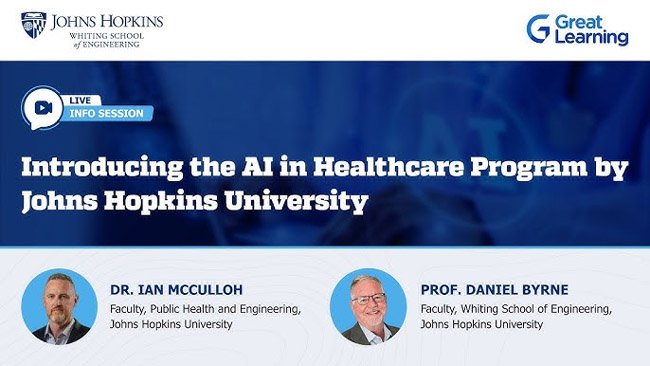
Great Learning, a leading global edtech company, has launched
theAI in Healthcare
program in collaboration with Johns Hopkins University (JHU), a globally
top-ranked university in medicine and public health. With a curriculum designed
by Johns Hopkins University faculty, this 10-week online program equips
professionals in healthcare to harness Artificial Intelligence for solving
challenges, improving decision-making, and driving innovation in their field.
It is ideal for medical, pharmaceutical, and biotech professionals,
researchers, healthcare consultants, policymakers, and healthtech leaders, and
doesn't require any programming or coding knowledge.
According to Grand View Research, the global AI in healthcare
market is projected to grow at a CAGR of 38.5% till 2030, with applications
ranging from diagnostics and hospital operations to drug discovery and
personalised medicine. Through this collaboration, Great Learning aims to
empower professionals in the healthcare industry to build systems that are
data-driven, efficient, and patient-centric.
Highlighting the importance of the program, Paul
Huckett, Associate Dean, Johns Hopkins Engineering Executive and Professional
Education, said, “We believe the future of healthcare will be shaped by how effectively
emerging technologies like AI are adopted. The AI in Healthcare program is
designed not just to teach technical skills but also to cultivate leaders who
can leverage AI to transform patient care, strengthen health systems, and drive
innovation responsibly. Through this collaboration with Great Learning, we are
creating a bridge between academic knowledge and real-world application.”
Learners begin with the basics of AI and the R.O.A.D.
management framework to understand how these technologies fit into healthcare.
They explore key machine-learning models, learn to measure their accuracy, and
discuss ethics, regulations, and the human factors that influence adoption. The
course covers predictive analytics to forecast complications, the use of large
language models in healthcare, and graph analytics to study health risks and
medication habits. Learners also work with epidemiological models such as
Markov and SEIR to track disease spread and plan pandemic responses. Practical
modules highlight common pitfalls in AI projects, best practices for managing
electronic health records, and strategies for scaling pilots across hospitals.
Talking about the collaboration, Mohan Lakhamraju,
Founder and CEO of Great Learning, said, "Artificial intelligence is
propelling healthcare into a new era, one where care is deeply personalised,
intelligent and safe. By collaborating with Johns Hopkins University, which is
world‑renowned for its medicine, nursing, and public health expertise, this
program ensures that learners benefit from both academic rigor and practical
industry application. The program combines rigorous AI learning with
healthcare-relevant applications, thus preparing professionals to not just
understand AI but to apply it effectively in clinical, operational, and
strategic healthcare settings."
This program offers a blend of recorded video lectures,
weekly interactive mentored sessions by industry experts, and live masterclasses by JHU faculty. They will also learn from real-world examples
through 8+ practical healthcare case studies covering applications of AI in
disease prediction, clinical workflows, and personalized patient care.
Learners will be awarded a Certificate of Completion and six
Continuing Education Units (CEUs) from Johns Hopkins University upon successful
completion of the program. As AI continues to redefine diagnostics, drug
discovery, and hospital operations, this program positions professionals at the
forefront of healthcare innovation, empowering them to transform challenges
into opportunities and contribute to more resilient, patient-focused health
systems.
© 2019 All Rights Reserved | democraticjagat2019 | Developed By DIIT IT SERVICES & SOLUTIONS