At
a time when consumers are increasingly tuning out traditional advertising due
to ad clutter and passive engagement, a new study by Snap Inc. and
Kantar India highlights a clear shift in how brands can break through. With 92% of Indian consumers believing AR will transform
how they shop, learn, or connect online, the
new study ’State of AR in India’ highlights the
growing role of Augmented Reality (AR).The study underscores AR’s power as a
high-impact advertising formatdelivering superior attention, stronger brand
outcomes, and influencing purchase decisions, particularly among Gen Z
audiences.
In India, Snapchat continues to
double down on a multi-format strategy, where AR is emerging as a critical
complement to video, driving deeper engagement and measurable business impact
for brands.
Attention: AR Drives Active,
Voluntary Engagement
AR is redefining how consumers engage with advertising
by capturing active attention rather than passive views.
AR Lenses are the #1 driver of attention, delivering
over 2X higher effectiveness and 3X greater efficiency in capturing voluntary,
active attention compared to other formats.2
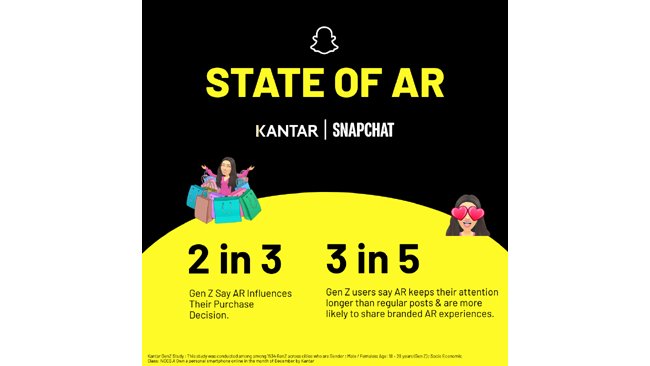
3 in 5 Gen Z users say AR keeps their attention longer
than regular posts.1
This ability to hold attention, despite being
skippable, positions AR as a uniquely powerful format in a cluttered digital
ecosystem.
Brand Advantage: From Discovery
to Decision-Making
Beyond attention, AR is proving to be a strong driver
of brand impact and purchase intent making it a valuable tool for advertisers.
2 in 3 Gen Z say AR helps them decide whether to try or buy a product,
understand a product better.
Importantly, AR usage in India is closely tied to
cultural moments from festivals to local events giving brands contextual
opportunities to connect more meaningfully with audiences.
Soumya Mohanty,
Managing Director & Chief Client Officer, South Asia, Insights Division,
Kantar, added “The
data shows that AR is reshaping consumer decision-making in measurable ways. It
enhances understanding, builds believability, and increases intent, three
critical drivers of conversion. For marketers, this represents a significant
opportunity to rethink how immersive formats can drive effectiveness across the
purchase journey, not just awareness.”
Adding on, Neha Jolly Sawhney, Head of Ad Revenue,
India, Snap Inc., said: India is one of the most dynamic AR markets globally,
and what we’re seeing is that AR is moving beyond experimentation and starting
to drive real results. When two in three Gen Z consumers say AR helps them
decide whether to buy, it signals that immersive experiences are no longer
upper-funnel engagement tools, they are
influencing real business outcomes. As a camera-first platform, we are excited
to continue building AR innovation that enables brands to move from attention
to action.
Content & Creator: AR Fuels
Creativity, Expression and Shareability
AR is not just an ad format it’s becoming
central to how Gen Z creates and shares content.
●
Nearly 3
in 5 Gen Z prefer posting interactive AR content over static photos or videos.1
●
Nearly 2
in 3 Gen Z say AR makes brand experiences more immersive and content more
exciting.1
●
Nearly 2
in 3 Gen Z find AR content more entertaining and fun to share with friends.1
●
Nearly 3
in 5 Gen Z say AR helps them express their personality and create more unique
content.1
This shift positions AR at the intersection of
media, creativity, and commerce where users are not just viewers, but active
participants and creators.
© 2019 All Rights Reserved | democraticjagat2019 | Developed By DIIT IT SERVICES & SOLUTIONS