Jaipur, March 23, 2023.
The first International Traditional
Reindeer Herding Championship was held in the Republic of Sakha (Yakutia) city
of Neryungri and the village of Iyengra on 15–19 March. The event was attended
by representatives of 14 regions of the Arctic and the Far East, China,
Mongolia, Iceland, and Greenland, as well as the Russian Association of Indigenous
Peoples of the North, the legislative authorities, and business, and members of
the Association of World Reindeer Herders. The championship was held as part of
the plan of events of Russia’s chairmanship of the Arctic Council in 2021–2023,
which are managed by the Roscongress Foundation.
“Reindeer herding is a major factor
in preserving the way of life and culture of Indigenous peoples, as well as a
link for many generations of residents of the Arctic regions. In addition, this
craft is of great economic importance for local producers and allows them to
remain in demand as suppliers on local food markets. In Russia, almost all Indigenous
Peoples of the North, Siberia, and the Far East herd reindeer. There are more
than 52,000 families of Indigenous peoples, many of whom lead a nomadic
lifestyle,” said Nikolay Korchunov, Chair of the Senior Arctic Officials and
Ambassador-at-Large for Arctic Cooperation of the Russian Ministry of Foreign
Affairs.
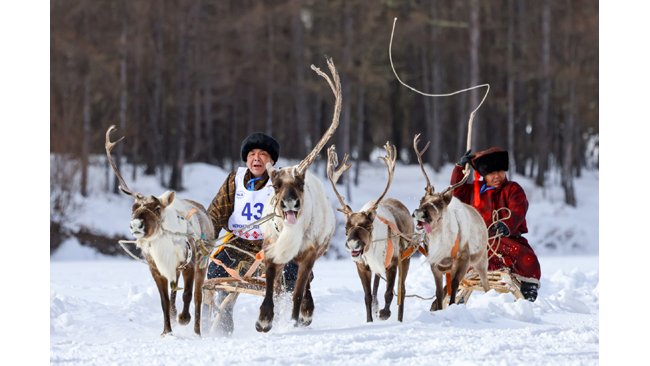
The championship contestants
competed in various types of competitions, including sled jumping, roping among
men and women, a combined relay race, catching reindeer, as well as racing on
reindeer sleds. In addition, competitions were held in professional Arctic
skills, such as building a fire in winter, cooking fish soup on a fire, and
dressing skins. The team of the Khanty-Mansi Autonomous District won the team
event, while representatives of the Yamal-Nenets Autonomous District took
second place, and the Republic of Sakha (Yakutia) finished third.
The International Conference
‘Sustainable Development of Reindeer Herding amidst Global Changes in the
Arctic’ was also held as part of the championship. Experts discussed strategies
to develop reindeer herding, training, and public-private partnerships in this
area. Participants in the conference’s plenary session discussed improvements
to legislation and state support for reindeer herding, as well as collaboration
with industrial companies.
In addition, the decision was taken during
the conference to establish an eastern branch of the Association of World Reindeer
Herders. “To continue the association’s work, an eastern branch needs to be
established in Russia. I propose including 20 regions of the Russian
Federation, as well as the People’s Republic of China and Mongolia in it,” Association
of World Reindeer Herders President Sergey Kharyuchi said. The central office
of the association’s eastern branch will be located in the Yamal-Nenets
Autonomous District city of Salekhard. Nine other reindeer herding regions of
the world located west of the Russian border will establish a western branch.
Both branches will operate under the same charter.
A project to build the Unique Iengra
ethno-tourist complex was also held during the championship. Construction will
start this year on the basis of the Evenki community. The corresponding
agreement was signed by representatives of the company Elgaugol, the Ministry
of Agriculture of the Republic of Sakha (Yakutia), and the Istok community of Indigenous
Peoples of the North. Construction costs are expected to amount to roughly RUB 130
million. Within five years of operation, the number of deer in the herd could double
to up to 2,000.
The event was organized by the
Association of World Reindeer Herders, the Ministry for the Development of the Russian
Far East and the Arctic, the Government of the Republic of Sakha (Yakutia), and
the Administration of the Neryungri District.
Russia is the chair of the Arctic
Council in 2021–2023. One of Russia’s main priorities is to develop human
capital in the region, including the Indigenous Peoples of the North. Russia
devotes special attention to maintaining the sustainability and viability of
the peoples of the North, promoting measures to adapt them to climate change,
improving people’s well-being, health, education, and quality of life, and
ensuring sustainable socioeconomic development throughout the region. The
Russian side has initiated projects to digitalize the cultural and linguistic
heritage of the Indigenous Peoples of the North, develop renewable energy
sources, create an international Arctic research station that runs on
carbon-free energy, and ensure biosecurity in the Arctic. In addition, Russia
is preparing draft proposals on the traditional medicine of Indigenous Peoples and
the development of creative industries in the Arctic, and is working on an
initiative to create Digital Museums of the Arctic.

© 2019 All Rights Reserved | democraticjagat2019 | Developed By DIIT IT SERVICES & SOLUTIONS