New Delhi, June 05, 2023.
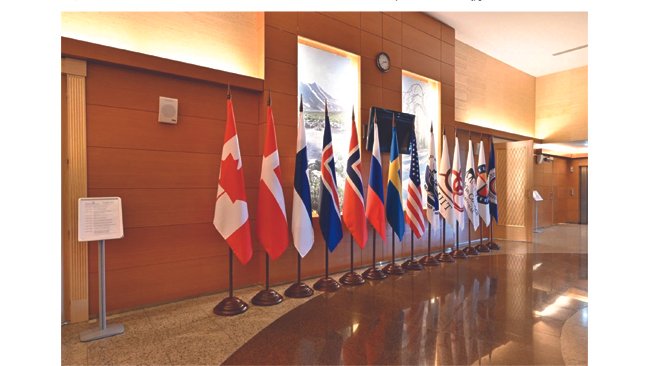
Russia handed over its chairmanship of the Arctic Council to Norway during the international organization’s 13th session, which took place on 11 May in Salekhard. The chairmanship of the Arctic Council passed to Russia on 20 May 2021 at a ministerial session in Reykjavik.
“The Arctic is a strategic region. This territory is of global importance for our country and for intensifying international cooperation. Russia has met all its obligations within the framework of the Arctic Council in full. [The country’s] primary attention was focused on four key priorities: ‘The People of the Arctic, Including Indigenous Peoples’, ‘Environmental Protection, Including Climate Change Issues’, ‘Socioeconomic Development’, and ‘Strengthening Arctic Cooperation’. Over a two-year period, our country held roughly 90 different events, including forums, conferences, roundtables, championships, festivals, and sports competitions. The chairmanship events were held in 24 cities and towns of Russia, including all nine regions of the Arctic zone of the Russian Federation. I am certain that all the events that took place and all the decisions that were made at them will support the development of the Russian Far North,” Russian Deputy Prime Minister and Plenipotentiary Representative of the Russian President in the Far Eastern Federal District Yury Trutnev said.
A cross-cutting priority of Russia’s chairmanship of the Arctic Council was to ensure responsible governance for the sustainable development of the Arctic. Based on its respect for international law, Russia contributed to the promotion of collective approaches for the development of the Arctic with a social, economic, and environmental balance. The events Russia organized were held as part of 11 thematic pillars that encompass all promising areas of the development of the northern latitudes. In particular, last year the St. Petersburg International Economic Forum featured a stand booth to the Arctic and Russia’s chairmanship for the first time, while the House of Indigenous Peoples at the Eastern Economic Forum was highly popular both among representatives of these ethnic groups and other guests of Vladivostok.
“During Russia’s chairmanship, issues concerning the sustainable development of the Arctic became an integral part of discussions at the key business platforms of our country. Now our main job is to preserve and enhance the valuable legacy of this chairmanship. We will continue to implement ambitious projects in the Arctic in accordance with our main priorities and will promote the results of this work on a regular basis as part of major international congress and exhibition events,” said Anton Kobyakov, Adviser to the Russian President and Executive Secretary of the Organizing Committee for Russia’s Chairmanship of the Arctic Council in 2021–2023.
The thematic pillar ‘Development of Human Capital in the Arctic’ included events at which the participants discussed the organization of medical support for the inhabitants of the Far North, ESG trends, ways to establish a partnership between the state and business for the benefit of citizens, as well as training and scientific support.
A separate
thematic pillar ‘Indigenous Peoples of the Arctic’ highlighted ways to ensure
sustainable development and preserve the heritage of ethnic groups who
traditionally reside in the northern territories. Russia’s chairmanship
showcased such events as the Arctic Indigenous People’s Summit (21 November
2022, Moscow), the ‘Russian North’ Indigenous Youth Forum (22–25 November 2022,
Salekhard), the International Seminar on the Preservation and Promotion of the
Languages of the Indigenous Peoples of the Arctic (16–18 March 2022, St.
Petersburg), and the International Traditional Reindeer Herding Championship (14–19
March 2023, Neryungri).
“In the Russian Arctic, world-class projects are being created to make a breakthrough in the technological, environmental, and energy markets. They will not only fill the Russian treasury for decades to come, but will also claim significant shares of world markets in the most promising sectors of the economy. Cargo from the Arctic mega-projects will fill the Northern Sea Route, via which cargo traffic should grow six times by 2030. All the measures to develop the Arctic economy aim to improve the quality of life of all residents of this strategically important region for our country,” Minister for the Development of the Russian Far East and Arctic Alexei Chekunkov said.
The events of the pillar ‘Climate Change and Ecology of the Arctic’ were devoted to issues on the environmental agenda. The experts and specialists who took part in these events discussed the problems of handling waste and microplastics in the northern latitudes, lifting flooded radioactive and hazardous objects from the seas of the Arctic Ocean, melting permafrost, and the bioremediation of the aquatic and terrestrial ecosystems of the Arctic coast. Participants in the large-scale Safe Arctic exercises in 2021 and 2023, for their part, worked on ways to prevent emergency situations in the Arctic.
During its chairmanship, Russia paid special attention to issues concerning the socioeconomic development of the territories of the Far North. During the conference ‘Investment and Trade in the Arctic’, which was held in September on the sidelines of the Eastern Economic Forum, experts considered prospects for cooperation between Russia and its foreign partners in the Arctic and opportunities for developing the Northern Sea Route, while building new logistics chains. In addition, the events held as part of this pillar included a discussion on the modernization of the telecommunications sector and digitalization in the Arctic, as well as the creation of a tourism industry in the North.
Cultural events were also a key part of the chairmanship programme. The following festivals were held over the last two years: Teriberka (16–17 July 2022, Murmansk Region), Bering Strait (2–7 August 2022, Anadyr), The Power of Colour (6–7 May 2023, Kirovsk), as well as the Gastronomic Festival of Northern Cuisine (10–11 December 2021, Moscow).
“In March
2022, the Arctic states of the West initiated a politicized and
counterproductive ‘temporary freeze’ on the Council’s full-scale activities.
Amidst these conditions, Russia continued to responsibly perform its functions
as chairman and consistently implement the activities of the programme of
Russia’s chairmanship (except for official meetings) and repurposed the
chairmanship mechanism during the period of this forced ‘freezing’ to search
for effective solutions to practical problems related to the development of our
country’s northern regions, which are enshrined in the Fundamentals of the
Russian Federation’s State Policy in the Arctic for the Period until 2035 and
the Development Strategy for the Arctic Zone of the Russian Federation and
Ensuring National Security for the Period until 2035,” said Nikolay Korchunov, Chair of the Senior Arctic Officials
and Ambassador-at-Large for Arctic Cooperation of the Russian Ministry of
Foreign Affairs.
Starting from May
2021, during Russia’s chairmanship, discussions were initiated for the first
time via the Arctic Council about the protection of the intellectual property
rights of Indigenous Peoples amidst globalization, the social responsibility of
entrepreneurs, as well as public-private partnershipsfor the sustainable
development of northern ethnic groups. Russia proposed numerous projects and
initiatives, in particular, related to the digitalization of the cultural and
linguistic heritage of Indigenous Peoples, the development of creative
industries and traditional Arctic medicine, the creation of an international
Arctic scientific station that runs on carbon-free energy, ensuring biosecurity
in the region, and the creation of a unified digital museum platform.
Improving the
efficiency of research activities and developing scientific cooperation was
also one of Russia’s main goals as chairman of the Arctic Council. In
particular, based on an initiative from Moscow State Institute of International
Relations, the Russian Ministry of Foreign Affairs signed an agreement on the
formation of the Interuniversity Consortium for Political and Legal Research in
the Arctic in 2022. The creation of this structure is a step towards forming an
all-Russian consortium of Arctic Universities that is open to international
partnerships. In addition, during the Northern Sustainable Development Forum,
an agreement was signed on the establishment of the Russian-Asian Consortium
for Arctic Research, as more than ten organizations became members of this
organization.
The plan for Russia’s
chairmanship of the Arctic Council was calculated until August 2023 from the
very beginning, so Russia will hold a number of events that aim to promote
socioeconomic development, preserve the ecology of the northern latitudes, and conduct
scientific studies of the Arctic. Some 20 events will take place in the coming
months, including: the International Conference on Biodiversity in the Arctic
and the International Forum on Specially Protected Natural Areas in the Arctic during
the St. Petersburg International Economic Forum 2023, the ‘Arctic. Breaking the
Ice’ Second Russian Forum and Festival of Volunteers, the Teriberka Arctic
Festival, the Bering Strait Festival, and the International Maritime Arctic
Educational and Scientific Expeditions ‘Training-through-Research’ on Research
Vessels. The chairmanship events are managed by the Roscongress Foundation.
© 2019 All Rights Reserved | democraticjagat2019 | Developed By DIIT IT SERVICES & SOLUTIONS